ADA Compliance for Barre Studios: 2026 Owner's Guide
Over 4,000 ADA lawsuits were filed in 2024. Barre studio owners must understand physical specs, staff training, digital access, and tax incentives for compliance.
Key Takeaways
- Existing facilities carry ADA obligations: Federal law requires barre studios to remove physical barriers in older buildings when "readily achievable"—meaning easy to accomplish without much difficulty or expense, scaled to the business's size and resources.
- Physical specifications often overlooked: Studios must maintain 30"x48" clearances between equipment, provide doorways at least 32 inches wide when open, eliminate thresholds above ½ inch, and ensure accessible pathways free of obstacles like bags and shoes.
- Compliance extends beyond construction: ADA obligations include staff training on modifications for members with disabilities, digital accessibility for websites and virtual classes, and creating an inclusive instructional environment, not just physical infrastructure changes.
- Enforcement carries substantial penalties: Non-compliance can result in Department of Justice civil penalties up to $110,000 per violation, private lawsuits with recoverable attorney's fees, and loss of federal funding eligibility.
- Tax incentives offset improvement costs: The IRS Disabled Access Credit provides up to 50 percent credit on qualified expenditures for eligible small businesses, while Section 190 allows deductions up to $15,000 for barrier removal.
Why ADA Compliance Matters for Barre Studios in 2026
Over 4,000 ADA-related lawsuits were filed in state and federal courts in 2024, with filings continuing to cluster in consumer-facing sectors with high foot traffic. While most litigation has targeted digital accessibility and restaurants, fitness and wellness businesses face increasing scrutiny. For barre studio owners—many operating in older buildings with limited square footage—ADA compliance presents both a legal obligation and operational challenge that few industry resources address directly.
A critical misconception persists among studio operators: that the ADA requires barrier removal in existing facilities, not just new construction. Title III of the ADA prohibits discrimination by private entities operating as places of public accommodation, which includes barre studios. The "readily achievable" standard applies to existing facilities, meaning studios must remove barriers that are easy to accomplish without much difficulty or expense, based on the business's size and resources.
Physical Accessibility Standards Studio Owners Miss
Federal law requires gyms to maintain a minimum of 30"x48" between all aisles, furniture, and equipment. For barre studios where mirrors, barres, and reformers occupy premium square footage, this spacing requirement often conflicts with revenue-maximizing class sizes. Entryways should feature doorways that are at least 32 inches wide when the door is open at a 90-degree angle to allow easy passage of wheelchairs and assistive medical equipment.
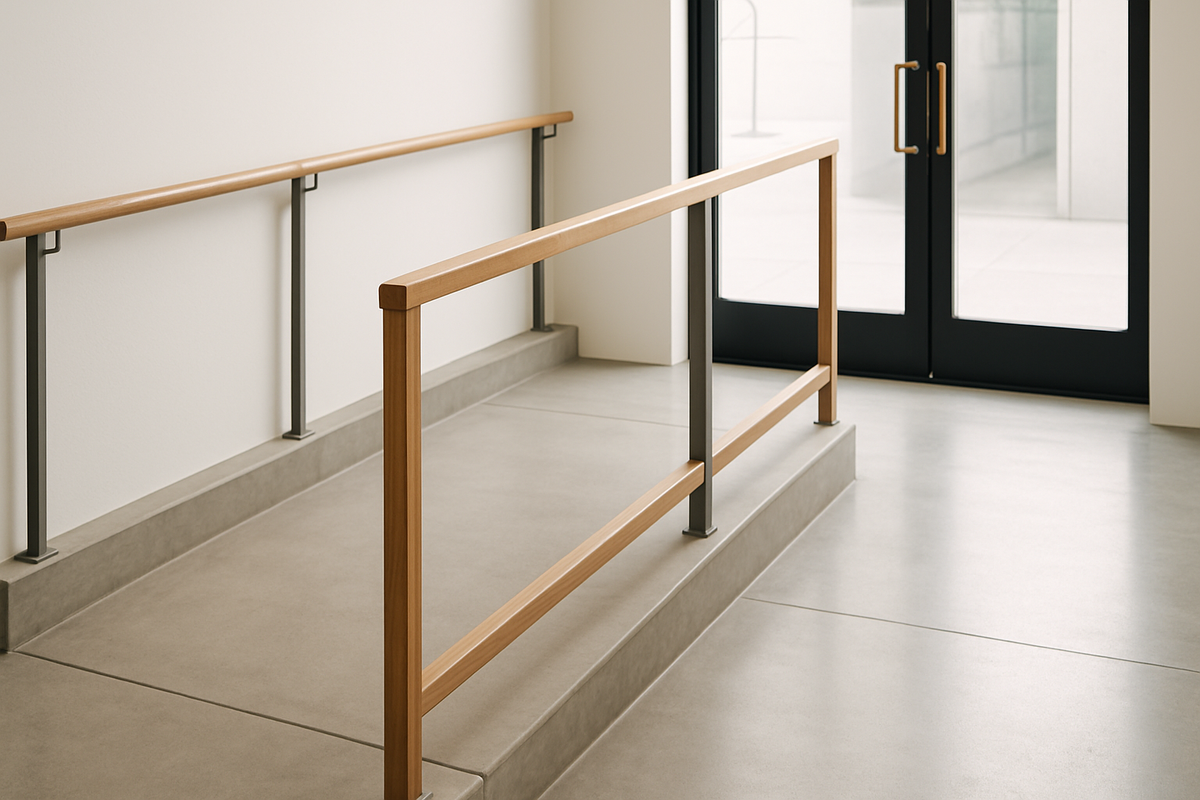
ADA standards also require business owners to eliminate thresholds higher than ½ inch and to put in ramps for people with mobility and physical difficulties. Many studios are located in buildings constructed before 1991 that do not meet these standards. For dance and barre studios specifically, pathways should be clear of dance bags, shoes, clothes, and water bottles, and owners should stay on top of snow removal on sidewalks and entryways.
Restroom and Common Area Requirements
At least one fixture—including toilets, sinks, and dispensers—must be accessible, with at least one enlarged standard stall, easy-to-use soap and towel dispensers, sink countertops with ample room for maneuvering, and faucet handles that are easy to operate. These modifications often require reconfiguring existing restrooms in older retail spaces where studios typically lease.
Instructional Access and Staff Training Requirements
Physical infrastructure represents only one dimension of ADA compliance. Classes should be held in spaces that are not overly crowded to allow for wheelchair access and easy movement for all participants, and instructors should remain open to feedback about participant needs. This operational requirement conflicts with the high-density class model many studios use to achieve profitability.
Staff in specialized positions should take trainings or complete certificate programs specific to their area of expertise to ensure individuals with a disability feel welcome and included. Staff members may become an Inclusive Fitness Specialist through the American College of Sports Medicine or earn other adapted fitness certificates. Studios exploring inclusive programming strategies have found that instructor training on modifications benefits all students, not just those with disabilities.
For barre classes, adjustable benches, lowered weight stacks, and hand-operated resistance machines are modifications that can make a difference. Applied to barre, this translates to offering seated positions, adjustable barre heights, or alternatives to standing combinations. Instructors trained in specialized instructor certification can better assess when modifications serve members and when referrals to medical professionals are appropriate.
Digital Accessibility for Websites and Virtual Classes
ADA compliance includes features like providing transcripts for audio or video content and including subtitles for videos. This applies to virtual or on-demand barre classes, class descriptions, and any instructional videos studios share with members or prospects. Many studios launched digital offerings during 2020 without considering accessibility, creating compliance gaps that persist in 2026.
Booking platforms, membership portals, and class schedule interfaces must accommodate screen readers and keyboard navigation. Studios that outsource web development or use third-party scheduling software remain liable for accessibility violations on those platforms.
Enforcement Trends and Liability Exposure
Non-compliance carries DOJ civil penalties up to $110,000 per violation, potential loss of federal funding, and exposure to private lawsuits where attorney's fees are fully recoverable. If an issue is not resolved, individuals can file a complaint with the Department of Justice, which oversees ADA compliance.
While barre studios have not yet seen the litigation volume restaurants and retailers face, the consumer-facing nature of the business and the physical accessibility challenges inherent in movement-based instruction create exposure. Studios with strong instructor training and liability protocols are better positioned to document good-faith compliance efforts.
Tax Incentives That Offset Compliance Costs
The Disabled Access Credit (IRS Form 8826) provides up to 50 percent credit on qualified expenditures for eligible small businesses, while Section 190 of the Internal Revenue Code allows a deduction of up to $15,000 for barrier removal. These incentives substantially reduce the net cost of widening doorways, installing ramps, reconfiguring restrooms, or upgrading digital platforms.
Eligible small businesses are those with gross receipts under $1 million or fewer than 30 full-time employees in the preceding tax year. Most independently owned barre studios qualify. The credit covers 50 percent of expenditures between $250 and $10,250, meaning a maximum credit of $5,000 per year. When combined with the Section 190 deduction, studios can recover a significant portion of compliance investments.
What This Means for Studio Operators
Editorial analysis, not reported fact:
ADA compliance is not a one-time construction project but an operational culture shift. Studios should conduct accessibility audits in 2026 focusing on three dimensions: physical infrastructure (doorways, spacing, thresholds, restrooms), instructional practice (class density, instructor training, modification protocols), and digital access (websites, booking platforms, virtual content). The "readily achievable" standard scales to business resources, meaning compliance is not all-or-nothing but an ongoing process of barrier removal as financial capacity allows.
The studios most vulnerable are those in older buildings with narrow doorways, those maximizing class density to improve per-square-foot revenue, and those offering virtual classes without captioning or transcripts. Studios should document accessibility assessments, improvement timelines, and financial constraints that limit immediate barrier removal. This documentation demonstrates good faith if a complaint arises.
Beyond legal obligation, accessible instruction expands the addressable market. Studios that train instructors on modifications, offer adjustable equipment, and create a welcoming environment for members with disabilities differentiate in a crowded market. The same modifications that serve wheelchair users—clearer pathways, uncluttered spaces, seated options—also benefit pregnant clients, older adults, and anyone recovering from injury.
Sources & Further Reading
- ADA Title III: Places of Public Accommodation, Department of Justice overview of private business obligations
- ADA Compliance for Existing Facilities, California Commission on Disability Access guidance on barrier removal and tax incentives
- ADA Standards for Fitness Facilities, Nexofit analysis of spacing and equipment requirements
- Inclusive Instruction for Clients with Disabilities, ACE Fitness guide to creating accessible fitness environments
- ADA-Compliant Spaces for Dance Studios, Rhythm Works overview of pathway clearance and operational practices
- Creating an Inclusive Gym Environment, Fitness On Demand discussion of staff training and certification programs
Editorial coverage of publicly reported industry developments. Barre Diary has no commercial relationship with any companies named.