Adding Pilates or Yoga to Your Barre Studio: What It Takes
Pilates bookings surged 66% in 2025, but barre studios face certification, space, and operational hurdles before adding new modalities. Here's what works.
Key Takeaways
- Pilates demand is surging: Reservations increased 66% between 2024 and 2025 on ClassPass, making it the most-booked boutique workout for the third consecutive year, while the USA boutique fitness market is projected to grow at 12.8% annually through 2032.
- Instructor certification is a major bottleneck: Barre instructors can cross-train, but full Pilates certification requires 134 hours including practice teaching and observation, while yoga instructors need a minimum 200-hour Yoga Alliance credential, compared to just 8 hours for barre certification.
- Space requirements differ significantly by modality: A single reformer needs 60 to 80 square feet including clearance, while mat-based classes require 20 to 25 square feet per person; heated yoga rooms and reformer studios have incompatible climate needs that complicate dual-use layouts.
- Revenue diversification drives profitability: Hybrid studios that combine group classes with high-margin private sessions and premium membership tiers bundling barre-yoga fusion or meditation add-ons show stronger retention and higher average revenue per member.
- Operational complexity scales faster than revenue: Multi-modality requires membership software that handles varied class durations, instructor qualifications, and equipment requirements without confusing members; scheduling too many options is a frequent mistake by new owners.
Why Barre Studios Are Looking Beyond the Barre
Boutique fitness is consolidating around multi-modality, and barre studio operators are feeling the competitive pressure. Pilates has emerged as the hottest boutique fitness modality of the post-pandemic era, earning its spot as the most-booked workout for the third year in a row on ClassPass, with reservations increasing 66% between 2024 and 2025.
The market is responding. In April 2025, Decatur launched WISEBarre Pilates Studio, a women-only fitness center offering mat and reformer Pilates, barre, yoga, spin, and personal training. Meanwhile, Richmond-based re+forme offers a combination of Pilates and Lagree, with Re+forme Method focusing on Pilates-based movements and Re+Set blending yoga-inspired stretching and mobility work.
It's common to see a single business offer both yoga and Pilates classes, plus perhaps barre or HIIT training, effectively becoming a boutique fitness hybrid. The logic is straightforward: cross-modality offerings can broaden market appeal and even out demand fluctuations when one format slows seasonally.
The Instructor Certification Reality
The single biggest operational challenge is not marketing or member demand. It is instructor readiness. Barre studio owners cannot simply add yoga or Pilates classes to the schedule without certified instructors, and the certification pathways require substantially more investment than many operators expect.
For barre instructors looking to cross-train, Balanced Body Barre certification takes just 8 hours, but you can only enroll if you already have prior experience teaching group classes. Full Pilates certification is a different commitment entirely. Mats 1-3 each last 16 hours, with 20 personal mat sessions, 15 hours of observation, and 35 practice student teaching hours required, bringing the total length of Balanced Body Pilates certification to 134 hours.
Yoga follows yet another standard. All yoga instructors must complete a minimum of 200 hours training through an accredited Yoga Alliance school, which is the industry baseline. For context, 47.7% of IBBFA's 7,000+ certified instructors had zero prior fitness certifications before earning their CBI, underscoring how accessible barre certification is relative to adjacent modalities.
Studios face a choice: invest months and thousands of dollars training existing barre instructors in Pilates or yoga, or hire already-certified instructors and manage a more complex payroll with varied expertise levels. Either path introduces friction that a single-modality studio avoids.
Space and Equipment: The Math Gets Tight Fast
A functional barre studio needs between 1,200 and 2,500 square feet, with 800 to 1,000 square feet of open studio floor for a class of 15 to 20, plus reception, changing rooms, and storage. Adding yoga and Pilates complicates the spatial equation significantly.
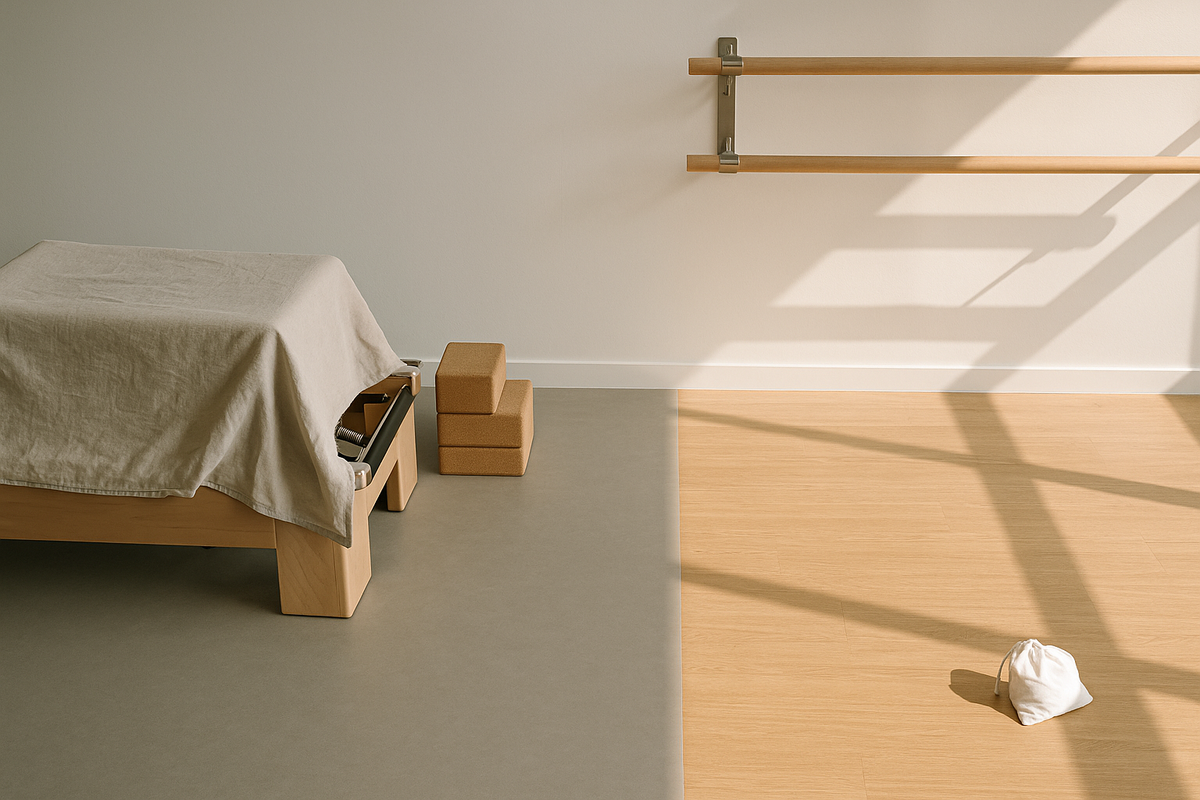
For mat-based yoga or Pilates classes, a good rule of thumb is 20 to 25 square feet per person, which allows enough room for a standard mat, full arm extension, and safe transitions between poses. That is manageable in most barre studios. Reformer Pilates is another story. A single reformer typically requires 60 to 80 square feet when you account for clearance around the machine and instructor access.
Climate control creates additional conflicts. Multi-modality requires broader instructor expertise and potentially different room setups, since a 105°F hot yoga room is not ideal for a Pilates reformer class. Some owners solve this by dedicating separate rooms to each modality, but that requires square footage most urban studios do not have.
For smaller studios, portable barres with folding legs provide space-efficient solutions, and by incorporating foldable items, studio owners can offer a broader range of classes without sacrificing valuable floor space. The trade-off is setup and teardown time between classes, which shortens the scheduling window and adds labor.
Revenue Models That Work and Pricing Pitfalls to Avoid
The hybrid boutique model combines group classes with high-margin private sessions and is often the most resilient model because it diversifies income streams. A yoga and Pilates studio hybrid model broadens appeal and increases revenue potential, particularly when premium membership tiers bundle services.
Barre studios are expanding beyond pure fitness into holistic wellness offerings, with barre-yoga fusion classes, meditation add-ons, and nutrition coaching packages becoming standard differentiators. Studios that bundle these into premium membership tiers see higher average revenue per member and stronger retention.
The pricing challenge is avoiding over-complication. Some owners create overly complicated schedules that provide too many options to their clients, and members evaluating 12 different class types across three modalities may experience decision fatigue rather than delight. Successful hybrid studios limit the menu to three to five core class types and reserve niche offerings for workshops or private sessions.
Operational Complexity: Software, Scheduling, and Member Communication
You need a membership system that handles class packs, unlimited monthly passes, and introductory offers without confusion, a check-in process fast enough to process 12 to 15 members in under 2 minutes, and scheduling tools that account for classical barre, cardio barre, barre-yoga fusion, prenatal barre, and private sessions, each with different durations, instructor qualifications, and equipment requirements.
A frequent mistake made by new barre owners is to invest in weak software systems. If classes are difficult to book, if billing is complicated, or if staff members are disorganized, new members will evaluate their experience negatively even with the best marketing in the world. Multi-modality magnifies this risk because instructor credentials, room assignments, and equipment availability must all align for each class slot.
Member communication becomes more demanding as well. Studios must clearly explain which classes require prior experience, which use specialized equipment, and which count toward which membership tier. Ambiguity drives support inquiries and cancellations.
What This Means for Studio Operators
Editorial analysis, not reported fact:
The boutique fitness market is moving toward multi-modality, and barre studios that remain single-format risk losing members to hybrid competitors. But adding Pilates or yoga is not a matter of simply buying a few reformers or yoga mats and updating the class schedule. The operational depth required—instructor certification timelines measured in months, spatial reconfigurations that may require separate climate-controlled rooms, software systems capable of managing multi-tier memberships and varied instructor qualifications—means this is a capital and operational investment, not a marketing experiment.
Studios with 1,200 to 1,500 square feet and a single instructor should focus on barre-yoga fusion or mat Pilates, both of which can share floor space and require lower certification barriers. Studios with 2,000-plus square feet, multiple instructors, and access to capital should consider dedicated reformer rooms and hiring already-certified Pilates instructors to avoid the training lag. In both cases, resist the urge to offer every format at once. Launch one new modality, prove member demand and operational competence, then expand.
The studios thriving in this transition are those that treat multi-modality as a business model shift, not a schedule add-on. They budget for instructor training or new hires, they invest in software that prevents scheduling chaos, and they communicate clearly with members about what each class type delivers. The studios struggling are those that assume cross-training an instructor over a weekend or squeezing reformers into a barre room will suffice. It will not.
Sources & Further Reading
- Athletech News: Pilates ClassPass booking data and market growth analysis
- Market.us: USA boutique fitness market forecast through 2032
- Balanced Body: Barre and Pilates certification pathways and requirements
- Trainer Academy: Comprehensive Pilates certification hour requirements
- Skelcore: Space requirements per person for yoga, Pilates, and HIIT classes
- WellnessLiving: Hybrid business model revenue strategies for boutique studios
- Richmond BizSense: re+forme multi-modality studio expansion case study
Editorial coverage of publicly reported industry developments. Barre Diary has no commercial relationship with any companies named.