Business Owner's Policy for Barre Studios: Worth It?
BOPs bundle liability and property coverage for $67–$75/month, but athletic participant exclusions can deny claims for injuries during class. Here's how to spot the gap.
Key Takeaways
- Business Owner's Policies for barre studios bundle general liability and commercial property insurance for $67 to $75 per month on average, but bundled savings mean nothing if exclusions leave you exposed during actual claims.
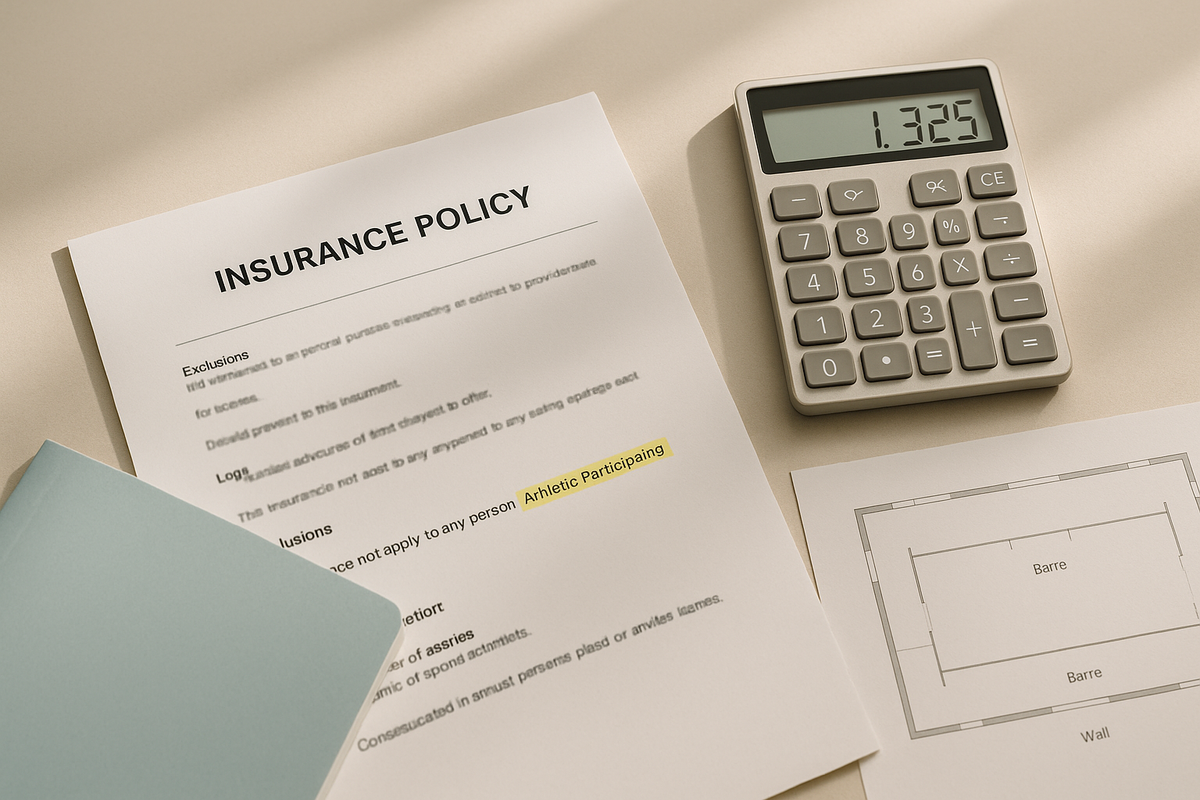
- Athletic participant exclusions hidden in standard BOP liability forms can deny coverage for client injuries during class—the policy may cover a visitor who slips in your lobby but not a member who gets hurt mid-class.
- Participant accident insurance fills the athletic exclusion gap for about $62 per month, paying injured members' medical bills regardless of fault so nobody has to sue to prove negligence.
- Pure Barre franchise owners must satisfy Xponential Fitness insurance requirements that include commercial general liability, professional liability for instructors, and property coverage with business interruption protection.
- Signed liability waivers help but are not a substitute for insurance—waivers improve your defense position but do not prevent lawsuits or replace coverage for actual claims.
What a BOP Actually Covers and What It Costs
A Business Owner's Policy bundles general liability coverage with commercial property insurance, protecting against client injuries and property damage while covering repair or replacement costs of your building and fitness equipment from vandalism and other covered claims. For sports and fitness businesses, the average BOP costs $67 per month with policy limits of $1 million per occurrence and $2 million aggregate, plus a $500 deductible.
Barre studios fall into a slightly higher bracket. Sport and fitness BOPs average about $75 per month, while dance studios face even higher pricing at $121 per month with identical limits. Overall, barre owners should expect to pay between $1,200 and $4,500 per year for a comprehensive insurance plan.
The bundling delivers real savings. By combining general liability and property insurance into a single policy, BOPs typically offer a reduced premium, often making them more cost-effective than separately purchased policies. But those savings only matter if the coverage actually applies when you file a claim.
The Athletic Participant Exclusion Trap
The most dangerous BOP pitfall sits buried in policy language most studio owners never read. The athletic participant exclusion uses the same liability form as standard commercial general liability policies, with the ISO version (form CG 21 01) removing coverage for injuries during athletic contests or exhibitions you sponsor. Broader versions used by some fitness carriers can reach any athletic activity you supervise.
In practice, this addition to your policy specifically excludes coverage for any athletic-related injury at your gym, creating a massive gap. A real-world scenario illustrates the danger: if a client falls off the barre during class, you may be told during a claim call that you have an Athletic Participant Exclusion in your liability policy, meaning you're not covered for any athletic injury that a member might sustain even though you are running a fitness facility.
This creates an absurd coverage paradox where the policy covers a visitor who slips in your lobby but not a member who gets hurt mid-class. Given that exercise and exercise equipment were linked to more than 500,000 injuries treated in U.S. emergency departments in 2024, this exclusion represents existential financial risk for studio operators.
How to Identify and Address the Gap
Your policy documents should clearly list all exclusions, but the language is often technical and easy to miss during renewal. Look for references to ISO form CG 21 01 or any language excluding injuries during "athletic activities," "contests," or "exhibitions." When this endorsement is attached, it creates a significant coverage gap for injuries to participants, and the insured organization needs to consider other risk management techniques or specialized insurance.
The solution is straightforward but adds cost. Pair the policy with participant accident coverage if the exclusion is there. Accident medical insurance averages about $62 per month for sports and fitness businesses. This coverage pays an injured member's medical bills regardless of fault, so nobody has to sue and nobody has to prove negligence.
Barre-Specific Equipment and Liability Considerations
Sprung floors, mirrors, and barres require ongoing maintenance, and these specialized installations create unique property and liability exposures. Underwriters increasingly ask about choreography review during application, and the documented process becomes defense evidence in overuse-injury professional liability claims.
Staff coverage adds another layer. Most studios and wellness centers require their employees to have their own barre insurance policy to ensure employees are properly protected from any unexpected injuries during service. Independent barre instructors pay only $179 per year for comprehensive liability insurance, while dance fitness instructors typically carry general liability plus professional liability at $140 to $270 per year for solo coverage.
Understanding liability waiver limitations is critical. A signed liability waiver helps, but it isn't a substitute for insurance. Waivers strengthen your legal defense and may deter frivolous lawsuits, but they do not prevent clients from filing claims or eliminate your need for coverage.
Franchise Insurance Requirements Add Complexity
Pure Barre requires proof of insurance as part of their licensing application, though you may need more insurance than they require or a different type in addition, depending on the risk profile of your business. You may also wish to explore professional liability insurance that covers activities and instruction provided in your capacity as a fitness professional, and general liability insurance that covers damage to the fabric of a building you lease.
The Pure Barre franchise insurance program provides franchisees with a simple and convenient way to secure broad, customized coverage at competitive rates which satisfies the insurance requirements under the Xponential Fitness franchise agreements. Through a streamlined online enrollment platform, franchisees can obtain commercial general liability (for franchise operations, including premises and participant legal liability), professional liability (for instructors), auto liability (for hired and non-owned autos), and property coverage (including business interruption and extra expense).
Understanding franchise insurance requirements across state lines becomes essential as barre brands expand nationally. Different states impose varying mandates, and franchise agreements layer additional requirements on top of statutory minimums.
When a BOP Makes Sense and When It Does Not
Studio size and risk profile determine whether a BOP delivers value. Personal training studio owners who purchase commercial gym policies designed for large facilities often overpay significantly. A $10,000 annual premium designed for a 15,000-square-foot facility is wildly excessive for a 1,200-square-foot studio. The studio owner needs robust professional liability coverage but faces lower premises liability exposure and typically operates with lower property values at risk.
Some studio owners use BOP products that bundle property and liability coverage at modest premium levels—$500 to $1,500 annually—appropriate for their risk scale. BOPs are particularly valuable for fitness businesses because they offer comprehensive protection at a lower cost than purchasing each type of coverage separately, making them an efficient risk management tool for gym owners with limited budgets.
However, the savings only matter if the exclusions don't leave you exposed. Bundling into a BOP is why the core cost stays near $86 per month rather than the sum of buying general liability and property separately. Signed liability waivers, staff certifications and CPR, equipment maintenance logs, and slip-and-fall prevention improve your loss history and future pricing.
What This Means for Studio Operators
Editorial analysis, not reported fact:
The BOP value proposition for barre studios hinges on a single question: does your policy contain an athletic participant exclusion? If yes, your bundled savings evaporate the moment a client gets injured during class. You've paid for coverage that applies only to non-athletic incidents, which represent a tiny fraction of your actual liability exposure.
Before renewal, request your full policy documents and search for ISO form CG 21 01 or any language excluding athletic injuries. If the exclusion exists, calculate the true cost of adequate coverage: your BOP premium plus $62 per month for participant accident insurance, plus individual instructor policies. Compare that total against unbundled quotes for standalone general liability (with no athletic exclusion), professional liability, and property coverage.
For Pure Barre and other franchisees, use the franchisor's insurance program as a baseline but verify it addresses your state-specific requirements and actual risk profile. A 3,000-square-foot studio in a high-traffic urban location faces different property and premises liability exposures than a 1,200-square-foot suburban space, yet franchise programs often offer one-size-fits-all packages.
Document everything: equipment maintenance logs, instructor certifications, incident reports, and choreography review processes. These records both reduce your underwriting risk (lowering premiums) and strengthen your defense if a claim goes to litigation. Insurance carrier requirements often exceed state minimums, so assume underwriters will ask for CPR certification, background checks, and safety protocols even where law does not mandate them.
Sources & Further Reading
- Insureon: Sports & Fitness Business Insurance Cost, average BOP pricing and accident medical coverage rates for 2026
- Vibe Fam: Dance Studio Insurance 2026, comprehensive coverage of athletic participant exclusions and equipment-specific risks
- Mindbody: Insurance for Fitness Businesses, participant accident coverage and liability waiver limitations
- NACAMS: Pure Barre Franchise Insurance Requirements, franchise program details and coverage components
- Sports Car Insurance: Personal Training Studio vs. Commercial Gym Insurance 2026, risk profile analysis by studio size
- Nexo Fit: Closing the Gaps Within Fitness Insurance, real-world claim scenarios and exclusion language
- Vibe Fam: Boutique Gym Insurance 2026, liability waiver limitations and risk management protocols
Editorial coverage of publicly reported industry developments. Barre Diary has no commercial relationship with any companies named.