Beginner's Guide: Choosing Studio vs. Home Barre Practice
Beginners in 2026 face genuine format choices between studio classes, digital subscriptions, and free platforms. The 4-class rule predicts who stays.
Key Takeaways
- Format choice now drives retention: Beginners in 2026 face a genuine decision between studio, digital subscriptions ($25-35/month), and free platforms, each offering distinct advantages in structure, cost, and community.
- First-class anxiety is a documented barrier: Group fitness anxiety stems from fear of judgment and not knowing what to do; studios mitigate this through 10-15 minute early arrival protocols, intake forms, and instructor briefings on modifications.
- The 4-class rule predicts retention: Members attending four or more classes in their first 30 days retain at twice the rate of those attending fewer than three, with one studio improving 90-day retention from 55% to 74%.
- Home practice requires progressive programming: Free YouTube content lacks structured advancement; paid platforms like Pure Barre GO ($29.99/month) and Barre3 build multi-week progressions that systematically increase difficulty and accelerate results.
- Hybrid memberships reflect 2026 buying patterns: Blended in-studio and digital access addresses dual demand for community energy and schedule flexibility, increasing lifetime value for studio operators.
- Investment barriers remain minimal: Studios provide all equipment; home practice requires only a chair, space, and grip socks, making barre one of the most accessible low-impact formats.
Why Beginner Anxiety Blocks Studio Adoption
Group fitness classes trigger specific anxiety patterns because beginners feel "on display" and fear judgment about doing movements incorrectly, according to research on gym anxiety published in SELF. This isn't irrational nervousness; it's a documented barrier affecting new clients across all group formats. Barre's technical vocabulary and unfamiliar positions (relevés, attitude lifts, and isometric holds) amplify the knowledge gap beginners perceive between themselves and regulars.
The anxiety compounds in studio environments where mirrors provide constant feedback and positioning near the barre creates visibility. Industry research on first-class psychology identifies comparing yourself to others and uncertainty about proper form as the top triggers. Beginners don't fear the workout itself; they fear looking incompetent while learning.
How Studio Onboarding Protocols Ease First-Class Nerves
Studios that retain beginners implement structured intake protocols starting before the client walks through the door. Pure Barre's first-class guidelines instruct beginners to arrive 10 to 15 minutes early to complete a client intake form, tour the studio, and discuss health history, injuries, and goals with the instructor. This pre-class conversation serves two purposes: it gives the instructor modification context and normalizes the beginner's status rather than hiding it.
During class, instructors walk first-timers through each movement with beginner-specific modifications. The most effective studios assign preferred spots (typically second or third row, near the instructor's sightline) rather than leaving placement to chance. Experts recommend calling the studio before the first visit to ask which class suits true beginners and what to wear, transforming an anonymous transaction into a relationship.
The 4-Class Retention Threshold and What It Reveals
Studio operators track a critical inflection point: members who attend four or more classes in their first 30 days retain at twice the rate of those attending fewer than three. One barre studio case study documented improving 90-day retention from 55% to 72% within four months, stabilizing at 74% by month six, by focusing onboarding energy on driving attendance frequency in week one through week four.
The threshold isn't arbitrary. Four classes represents enough repetition to internalize terminology, recognize other regulars, and experience post-class endorphin patterns. It's the point where the workout shifts from bewildering to familiar. Studios that treat the first 30 days as a distinct phase, with check-in texts, progress milestones, and explicit next-class scheduling, convert trial members into retained clients at measurably higher rates.
Home Practice vs. Studio: The Format Decision Tree
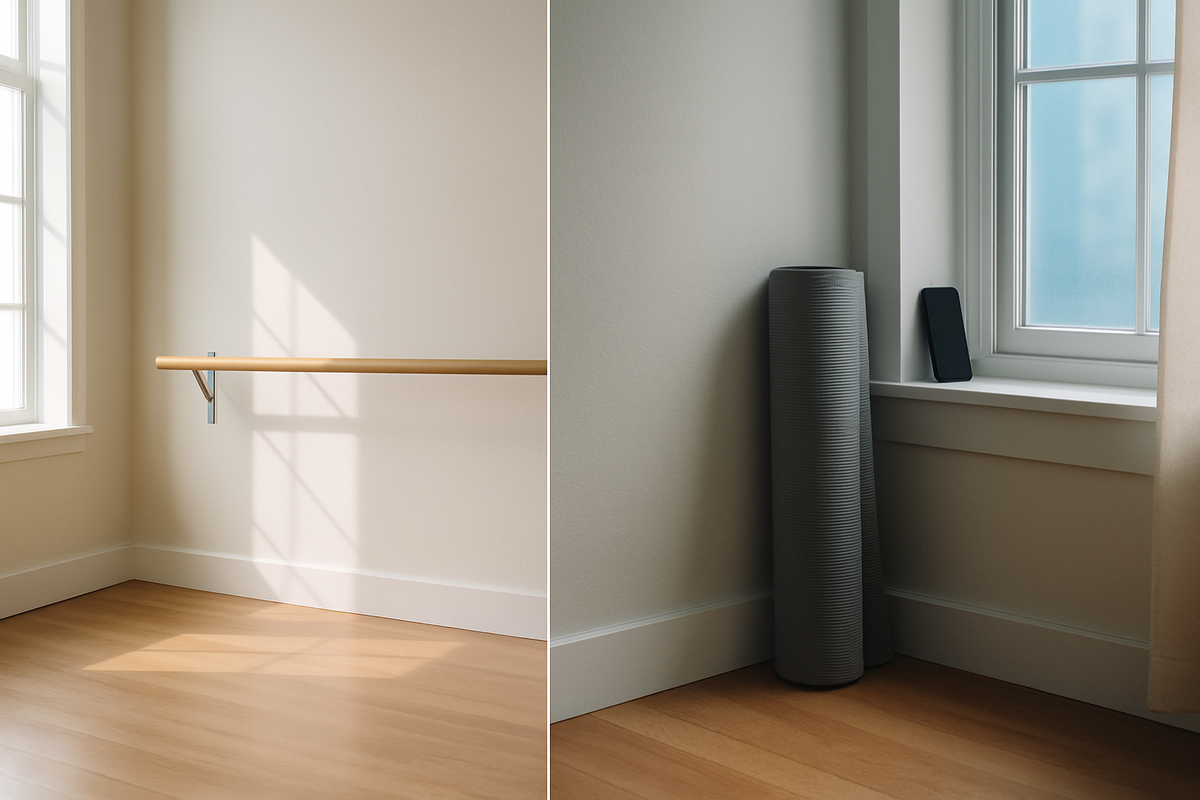
Barre's low-impact, minimal-equipment requirements make it uniquely suited to home practice. All a beginner needs is a chair for balance and space to extend limbs. Grip socks prevent slipping on hardwood or tile and replicate the studio barefoot feel. The pandemic normalized home workouts, and as of 2026, digital barre subscriptions remain a growth category alongside rebounding studio attendance.
The format decision hinges on three factors. Studio classes offer real-time form correction, scheduled accountability, and social energy. Digital subscriptions ($25-35/month for platforms like Pure Barre GO at $29.99) cost less than a single studio class and enable three to four weekly sessions for consistent results. Free YouTube content from channels like Barre3 and Popsugar Fitness works for exploration but lacks progressive programming, meaning beginners may repeat the same difficulty indefinitely without a clear advancement path.
The real value of paid platforms is structured progression: multi-week programs that systematically increase difficulty and introduce new movement patterns. This produces faster, more consistent results than random class selection. Studios cost $25-35 per drop-in; a monthly subscription pays for itself after attending once.
Hybrid Memberships Reflect 2026 Buying Patterns
The studio-versus-digital binary has collapsed. Members in 2026 want in-person energy plus digital convenience when schedules tighten. They're choosing both, not either-or. Studios responding to this shift now offer hybrid memberships bundling unlimited in-studio access with companion app subscriptions, increasing lifetime value without expanding physical footprint.
This matters for beginners specifically because the first 30 days determine retention, yet life disruptions (travel, illness, schedule conflicts) often derail momentum. Hybrid access lets a beginner maintain practice rhythm through digital classes when studio attendance isn't possible, preserving the 4-class threshold. Operators report hybrid members attend more total sessions (studio plus digital combined) than studio-only members, compounding the retention effect.
What Equipment Beginners Actually Need
Barre's accessibility stems partly from its minimal gear requirements. Studios provide all equipment: light weights (typically 1-3 lbs), resistance bands, sliders, and the barre itself. Beginners bring nothing except grip socks with traction dots on the soles. Most studios require socks rather than bare feet or shoes; the grip prevents slipping during single-leg balance work and creates a hygienic barrier.
For home practice, the investment barrier remains equally low. A sturdy chair substitutes for the barre, and grip socks cost $8-15. Optional purchases include a yoga mat (for floor work comfort) and light dumbbells, but neither is mandatory to start. This low friction removes a common beginner objection: the fear of investing in specialized equipment before knowing whether the format fits.
What This Means for Studio Owners
Editorial analysis — not reported fact:
The beginner landscape has fundamentally changed. You're no longer competing only with other studios; you're competing with $30/month digital subscriptions that deliver structure and convenience. Your advantage isn't exclusivity; it's the experience assets digital can't replicate: real-time correction, social proof, and physical community. Lean into those.
First 30 days should be treated as a distinct operational phase with different economics. A beginner who hits four classes and stays 12 months generates $1,800-2,400 in lifetime value (assuming $150-200 monthly spend). Investing disproportionate attention into those first four visits — whether through proactive outreach, dedicated beginner class times, or buddy pairing — has measurable ROI. If you're not tracking first-month attendance as a retention predictor, start today.
Hybrid models aren't cannibalizing studio revenue; they're expanding total engagement. A member who does two studio classes and two app classes weekly is more retained, more results-driven, and more likely to refer than a member doing one studio class. If you don't offer a digital component in 2026, you're forfeiting members during the exact life moments (travel, weather, childcare gaps) when they're most at risk of churning.
Sources & Further Reading
- SELF: Why Gym Anxiety Is Real and How to Overcome It — Research on group fitness anxiety and judgment fears
- Pure Barre: Your First Class Guide — Studio onboarding protocols and what beginners should expect
- Mindbody: Member Retention Strategies That Work — The 4-class retention threshold and case study data
- Shape: Best Online Barre Classes and What Makes Them Worth Paying For — Comparison of paid platforms and progressive programming value
- Athletech News: Fitness Business Trends in 2026 — Hybrid membership growth and digital adoption patterns
- Women's Health UK: At-Home Barre Workout Guide — Equipment requirements and home practice setup
- Verywell Fit: How to Prepare for Your First Barre Class — Pre-class preparation and anxiety management tips
Editorial coverage of publicly reported industry developments. Barre Diary has no commercial relationship with any companies named.