Franchise vs. Independent Barre Studios: The 2026 Math
Independent barre studios achieve 54% profit margins vs. 22% for Pure Barre franchises. Why the gap is widening and what territorial protections really mean.
Key Takeaways
- Profit margins for independent studios are more than double those of franchises: owner-operated independent barre studios achieve 54% profit margins compared to 22% for the average Pure Barre franchise, meaning independents keep more than twice as much of every revenue dollar.
- Startup costs favor independents by a 10:1 ratio in lean models: budget independent studios can launch for $40,000 to $55,000, while franchise investments range from $300,000 to $650,000, with Pure Barre charging a $60,000 franchise fee plus 9% of gross sales in ongoing royalties and marketing fees.
- Territorial protections are weaker than most franchisees expect: barre3 grants a typical one-mile radius with significant carve-outs allowing the franchisor to operate online, co-brand, or authorize overlapping territories, and studio owners report corporate-owned locations opening within 10 miles and cannibalizing established franchisee client bases.
- Creative control is the starkest operational divide: franchise agreements limit programming to brand-approved formats with little deviation, while independent certification allows owners to add modalities, adjust pricing, and respond to local member demand without headquarters approval.
- The barre industry is growing rapidly but margin pressure is intensifying: U.S. barre participation grew 13% from 2022 to 2023, reaching 4.3 million participants, but rising rent, instructor wages, and energy costs are compressing studio profitability across both models.
- Major franchises are betting on format diversification: Pure Barre, barre3, and The Bar Method have all launched strength, cardio, and mobility classes in 2025-2026 to compete with hybrid boutique competitors and retain members seeking cross-training options.
The Profitability Gap: Why Independents Keep Twice as Much Per Dollar
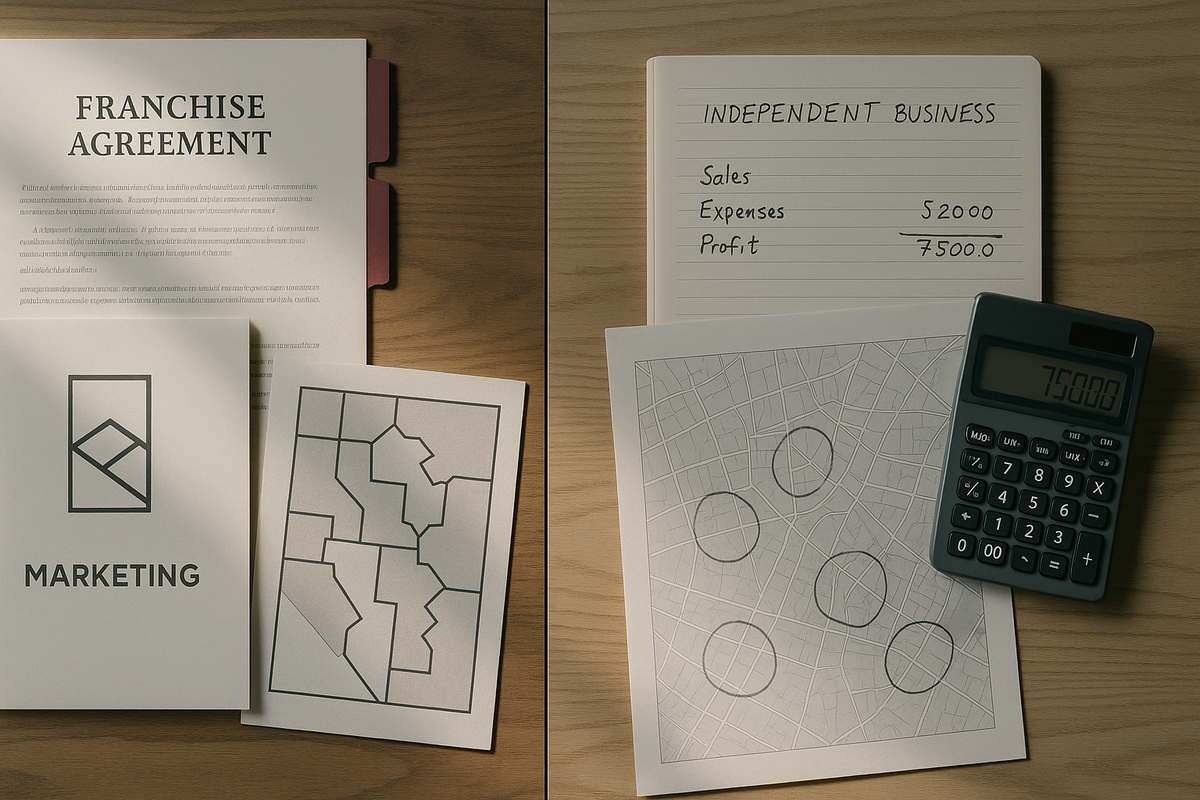
The financial math separating franchise and independent barre studios has become impossible to ignore in 2026. According to industry financial modeling, an owner-operated independent barre studio achieves a 54% profit margin, compared to just 22% for the average Pure Barre franchise. That means for every $100,000 in revenue, an independent owner nets $54,000 while a Pure Barre franchisee keeps $22,000.
The primary culprit is fee drag. Pure Barre charges a 7% royalty on gross sales and a 2% brand development fee, totaling 9% of all revenue before the owner pays a single instructor or utility bill. For the average Pure Barre studio generating $368,588 annually, that's over $33,000 sent to corporate before calculating local operating costs. Independent studios pay zero royalties and control their own marketing spend, redirecting that 9% directly to margin or reinvestment.
Scale reveals even sharper contrasts. A larger independent studio with 200 members and a hired manager generates $372,000 in revenue and $171,960 in net profit, a 46% margin. Meanwhile, only the top 25% of Pure Barre studios reach a 30% margin, earning $174,036 in profit on $588,040 in revenue. The median Pure Barre franchisee who does not teach classes takes home approximately $82,000 per year.
Startup Investment: The $40,000 Studio vs. the $300,000 Franchise
Capital requirements create the starkest barrier to entry. A budget independent barre studio can open for $40,000 to $55,000, a mid-range independent studio costs $120,000 to $160,000, and even a premium independent build-out typically runs $280,000 to $380,000. Franchise economics tell a different story.
Pure Barre requires a $60,000 franchise fee, with total investment ranging from $300,000 to $650,000 when build-out, equipment, and working capital are included. barre3 franchises cost $280,000 to $555,000, while The Bar Method requires $350,000 to $500,000. For context, an aspiring owner could open and fully equip five budget independent studios for the price of a single mid-range Pure Barre franchise.
The return timeline matters, too. One Reddit studio owner reported opening her first location in 2012 with $45,000 and reaching profitability in under two years. She now operates three studios. That trajectory is uncommon but instructive. Lower upfront capital and zero royalty drag allow independent owners to retain more early revenue for debt paydown and reinvestment rather than servicing franchise fees indefinitely.
Territorial Protections Are Weaker Than Franchise Disclosure Documents Suggest
Encroachment risk is the most emotionally charged issue in franchise barre ownership. barre3 grants franchisees an authorized territory with a typical one-mile radius, though the size and shape vary based on demographics, competition, and market characteristics. That sounds reassuring until you read the fine print.
barre3 reserves the right for itself, its affiliates, or authorized third parties to engage in various business activities within a franchisee's territory, including online sales, training at non-barre3 facilities, co-branded ventures, and overlapping territories in certain cases. In practice, studio owners report more aggressive moves. Multiple franchise owners describe corporate-owned studios opening within 10 miles of established franchise locations, sometimes after just three years of a franchisee building a loyal member base.
The math is brutal. If a franchisee has spent $400,000 on startup costs, paid 9% royalties for three years, and built a studio generating $400,000 annually, a corporate location opening seven miles away can siphon 30% to 50% of the client base overnight. The franchisee still owes the same lease, the same loan payments, and the same royalties on declining revenue. Independent studios face competitive pressure from new entrants, too, but they control pricing, programming, and partnerships without seeking franchisor approval.
Creative Control: Brand Consistency vs. Market Responsiveness
Franchise agreements prioritize uniformity. Most barre franchises limit programming to only what the franchise allows, with little to no deviation. That means if your members ask for a prenatal barre series, a teen strength class, or a partnership with a local physical therapist, you need corporate approval. If the answer is no, you lose the revenue opportunity or risk violating your franchise agreement.
Major franchises are evolving their offerings, but on their own timeline. The Bar Method launched Bar Strength in 2025, amplifying signature barre exercises with weight work and circuit training. barre3 introduced b3 Strength, b3 Cardio, and b3 Mindful Flow in early 2026, each tailored to functional benefits for daily life. These are smart pivots in a market where the global boutique fitness industry is projected to reach $54.8 billion by 2029, up 38% from 2024. But the rollout is centralized, and local franchisees cannot beta-test ideas without headquarters buy-in.
Independent studios operate with full creative latitude. Independent certification provides freedom from licensing fees and franchise limitations, allowing owners to blend modalities, adjust class lengths, price experimentally, and partner with complementary wellness providers. In a year when U.S. barre participation grew 13% to 4.3 million participants, the ability to respond to local demand in real time is a material competitive advantage.
Franchise Expansion Strategies: Consolidation and International Growth
Pure Barre, operating under Xponential Fitness, now has over 500 studios across the U.S. and Canada, making it the clear category leader by unit count. barre3 achieved 20% franchise expansion over the past year, accelerated by its acquisition of The Barre Code, which added 22 new franchise studio owners. The Bar Method operates 76 women-owned studios across 21 states, with concentrations in California, New York, and New Jersey.
International ambitions are ramping up. The Bar Method's master franchisee, Fast Fitness Japan, expects to open its first Tokyo studios in early 2025. barre3 is exploring international expansion and aims to sign and open 50-plus new studios in the near future. These moves signal confidence in the barre category but also intensify encroachment risk for existing franchisees as brands saturate metro markets to hit growth targets.
What This Means for Studio Owners
Editorial analysis — not reported fact:
If you are evaluating franchise vs. independent ownership in 2026, start with the financial math, not the brand appeal. A 54% margin independent studio generates $108,000 in profit on $200,000 in revenue. A 22% margin Pure Barre franchise needs $491,000 in revenue to deliver the same $108,000 profit, and it must send $44,190 of that revenue to corporate as royalties and marketing fees. The margin gap is structural, not a reflection of operator skill.
Territorial protection language in franchise disclosure documents deserves line-by-line scrutiny with an attorney who specializes in franchise law. Ask explicitly: Can the franchisor open a corporate location within my territory? Can they authorize another franchisee to operate online classes targeting my zip codes? What recourse do I have if my revenue drops 40% after a new location opens eight miles away? If the answers are vague or the carve-outs are broad, assume encroachment risk is real.
Creative constraints matter more as the market matures. In 2026, barre is no longer novel. Your competitive set includes Pilates studios with reformers, strength-focused boutiques, and hybrid models offering yoga, cycling, and functional training under one roof. If your franchise prohibits you from adding a 30-minute express format, hosting workshops, or partnering with a registered dietitian, you are competing with one hand tied. Independent ownership is operationally harder—you build your own brand, you source your own liability insurance, you design your own instructor training—but you control the product and capture the upside.
Finally, consider the growth path. Franchise owners scaling to multiple units still pay 9% on every location's gross revenue forever. Independent owners scaling to three or five studios keep that 9%, which funds faster expansion, higher instructor pay, or owner distributions. The operator who opened three independent studios on $45,000 in startup capital would have paid over $1 million in cumulative franchise fees had she chosen Pure Barre instead, assuming $400,000 average revenue per location over a decade. That is not a rounding error. That is retirement savings, a down payment on real estate, or seed capital for a fourth and fifth studio.
Sources & Further Reading
- NBC News coverage of barre studio profitability and independent vs. franchise economics — detailed financial modeling and margin comparisons
- Pure Barre franchise information — official fee structure, investment ranges, and average unit economics
- barre3 franchise opportunity details — territorial protection language and franchise cost breakdown
- The Bar Method franchise requirements — investment thresholds and studio count by state
- Athletech News reporting on new barre class formats from major franchises — coverage of Bar Strength and barre3's 2026 launches
- Athletech News on barre3's 20% expansion and Barre Code acquisition — franchise growth strategies and unit economics
- Sports & Fitness Industry Association 2023 participation report — barre growth from 3.8 million to 4.3 million U.S. participants
- IBISWorld boutique fitness industry projection — $54.8 billion global market forecast for 2029
- Reddit studio owner case study — independent studio startup and multi-unit scaling timeline
- Reddit franchise encroachment experiences — franchisee reports of corporate location cannibalization
Editorial coverage of publicly reported industry developments. Barre Diary has no commercial relationship with any companies named.