Design, Models & Movement: Inside the 2026 Barre Studio Spotlight
Owner-operated barre studios achieve 54% margins versus 22% for franchises, while design investment and consolidation reshape the sector in 2026.
Key Takeaways
- Owner-operated independent barre studios achieve 54% profit margins, more than double the 22% margins typical of Pure Barre franchises, according to industry financial analysis.
- Design investment has become a competitive moat, with leading studios incorporating spa-like amenities, architectural distinctiveness, and materials like recycled construction elements and branded metalwork to differentiate in crowded markets.
- Barre3 drove 20% franchise expansion in 2025 through strategic acquisitions of The Barre Code (22 studios) and Studio Barre (11 studios), growing its network to 206 women-owned, owner-operated studios.
- Pure Barre's Define format generated 15% same-store sales growth in 2023 by adding strength training with heavier weights to its traditional low-weight, high-rep model, per Athletech News reporting.
- Client referrals drive 60% of new Barre3 sign-ups, making community-building and member experience the primary revenue lever rather than paid acquisition channels.
- Break-even thresholds differ drastically by model: independent studios need just 55 members versus 155 for Pure Barre franchises, with payback periods of 1-2 years versus 5.5 years respectively.
Why Consolidation and Design Investment Define 2026
The barre sector is experiencing simultaneous consolidation and design differentiation as operators compete for a share of the 81 million Americans who now hold fitness memberships, a record high reported by the Health & Fitness Association. Barre3's acquisition spree in 2025 added 33 studios across The Barre Code and Studio Barre, while Pure Barre's Define format delivered 15% same-store sales growth in 2023. At the same time, top-performing studios are treating interior design as a membership driver, investing in spa-like lobbies, architect-designed spaces, and branded material palettes to create experiences that justify premium pricing.
This convergence matters because the boutique fitness sector now represents 40% of the overall health club market, with 121% growth over four years. As market share consolidates among well-capitalized franchises, independent operators are leveraging design and owner-operator economics to defend profitability.
Profitability Gap: Owner-Operated Studios Versus Franchises
The financial performance gap between independent and franchise models has widened to a stark divide. According to detailed financial modeling published by Barre Responsibly, an owner-operated independent studio with 120 members generates $223,200 in annual revenue and $121,440 in net profit, a 54% margin. By contrast, the average Pure Barre franchise achieves a 22% profit margin, yielding approximately $82,000 annual income for an owner who does not teach classes.
Break-even thresholds amplify this gap. A small independent studio reaches profitability at 55 members and recoups its $40,000 to $55,000 initial investment in one to two years. The average Pure Barre franchise requires 155 members to break even and takes 5.5 years to recover an initial investment exceeding $400,000, per the same analysis. The higher franchise investment reflects ongoing 7% royalty fees and 2% marketing fees on gross revenues, costs that independent operators avoid entirely.
This financial reality underpins the strategic calculus for operators considering expansion. Owner-operators who teach retain more than twice as much of every revenue dollar compared to absentee franchise owners, though they trade capital efficiency for sweat equity.
Design as Membership Driver: Spa Aesthetics and Architectural Investment
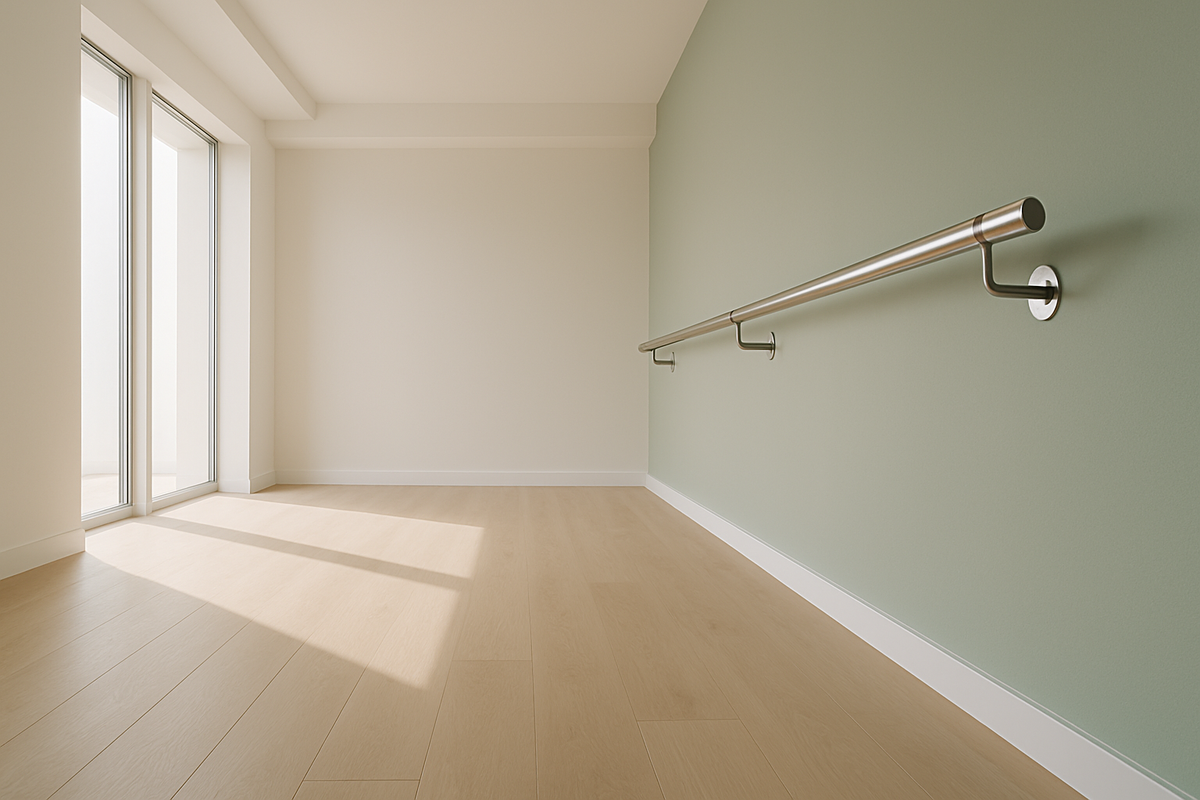
Leading studios are deploying design as a differentiation strategy in markets where barre options proliferate. Pop Physique's 4,000-square-foot flagship on Sunset Boulevard in Los Angeles features a vine-covered exterior, hardwood floors, and what observers describe as a "bubbly aesthetic interior" targeting the Creative Class. A Portland studio profiled in industry coverage uses recycled construction materials, custom metalwork, and gold-toned branded wallpaper to create a lobby styled like an upscale loft, making clients "feel more like you are going to the spa than to a workout."
The Bar Method's San Luis Obispo location exemplifies this trend with floor-to-ceiling windows that flood the reception area with natural light, creating what members describe as "a gorgeous lofty space that makes you feel more like you are at a spa than a workout facility." These investments reflect broader wellness design trends incorporating mini lounges within fitness spaces, cozy niches in changing rooms, and anterooms for pre- and post-class gathering, as reported in architectural industry coverage.
The design premium appears justified by membership economics. Studios emphasizing experiential differentiation can command higher price points and improve retention in a sector where The Bar Method reports a 3.6% attrition rate, significantly below industry averages.
Franchise Models: Investment Requirements and Revenue Drivers
Current franchise investment thresholds reflect the sector's maturation. Barre3 studio costs range from $408,675 to $650,851, with 122 reporting studios averaging $413,794 in annual unit volume as of recent franchise disclosure documents. Pure Barre franchise investment spans $314,000 to $629,000, with the 7% royalty and 2% marketing fees cited above.
Revenue models center on recurring membership streams. Barre3 studios offer unlimited memberships bundling in-studio and online access alongside 4-class and 8-class monthly plans plus class package options, creating predictable cash flow. Client referrals drive approximately 60% of Barre3's new sign-ups according to franchise expansion reporting, making member experience and community-building the dominant acquisition channel rather than paid media.
Barre3's Play Lounge childcare offering removes a primary barrier for mothers of young children, immediately expanding the addressable client pool. The Bar Method differentiates through a science-backed, kinesiology-based technique supported by on-staff physical therapists, positioning the brand as clinically grounded in a market where many barre offerings emphasize aesthetics over biomechanics.
Consolidation Trajectory: Acquisitions and Market Concentration
The 2025 acquisition wave consolidated market share among the largest players. Barre3's purchase of The Barre Code in 2023 added 22 franchise studio owners, with plans to convert those locations to the Barre3 format, targeting markets Barre3 had not yet entered. The subsequent Studio Barre acquisition brought 11 studios across California, Montana, Rhode Island, and South Carolina into the Barre3 network, which now encompasses 206 women-owned, owner-operated studios. Barre3 has stated plans to sign and open 50-plus new studios in the near term.
Pure Barre, established in 2002, operates over 640 locations across 48 states, Canada, and Japan, with high concentrations in California, Illinois, Florida, Massachusetts, Georgia, and Colorado. The Define format introduced strength training with heavier weights alongside legacy Align (recovery and flexibility) programming, generating the 15% same-store sales lift cited earlier.
Industry observers note that financially strong chains are acquiring distressed independent gyms or smaller rivals to expand market share, a trend consistent with broader boutique fitness consolidation. The 121% growth in boutique fitness over four years has attracted capital, accelerating M&A activity as brands race to achieve regional density and national footprint.
What This Means for Studio Owners
Editorial analysis — not reported fact:
The profitability data suggests owner-operators willing to teach should seriously consider independent models or carefully evaluate franchise economics before committing capital. The 54% margin available to owner-taught independents versus 22% for franchises represents a structural advantage that compounds over years. If you can build a 120-member base without franchise brand support, you retain an additional $40,000 to $50,000 annually compared to a franchise scenario, funds that can accelerate debt payoff, finance design upgrades, or fund geographic expansion on your own terms.
For operators choosing the franchise route, the differentiation strategies deployed by Barre3 and Pure Barre offer clear playbooks. Barre3's 60% referral-driven acquisition model and Play Lounge childcare demonstrate how removing friction and rewarding community can lower customer acquisition costs and widen the client funnel. Pure Barre's Define format shows that format innovation can drive double-digit same-store sales growth even in mature markets, suggesting that stale programming is a fixable problem.
Design investment is no longer optional in competitive metro markets. If your lobby and studio floor look identical to the three other barre options within two miles, you are competing solely on price, schedule convenience, and instructor charisma. Spa-like aesthetics, distinctive materials, and social gathering spaces create Instagram moments and word-of-mouth differentiation that justify premium pricing and improve retention. The Bar Method's 3.6% attrition rate demonstrates that design and experience investments pay measurable returns in member lifetime value.
Finally, the consolidation wave creates both threat and opportunity. Independent operators in markets targeted by Barre3 or Pure Barre expansion should expect intensified competition and potential acquisition overtures. If you have built a profitable, design-forward studio with strong retention, you may be an attractive acquisition target. If you are considering opening a new location, conducting competitive intelligence on franchise expansion plans in your target market is now essential due diligence.
Sources & Further Reading
- Barre3 franchise expansion and acquisitions coverage by Franchising.com — details on The Barre Code and Studio Barre acquisitions, studio count, and growth targets
- Independent versus franchise barre studio financial analysis by Barre Responsibly — profit margins, break-even member counts, payback periods, and investment requirements
- Pure Barre Define format and same-store sales growth reported by Athletech News — program details and 2023 financial performance
- Barre3 franchise information and investment range — official franchise disclosure and business model details
- Pure Barre franchise investment and fee structure — royalty rates, initial investment, and studio count
- The Bar Method franchise information and attrition rate — kinesiology-based technique and retention metrics
- Health & Fitness Association membership statistics — record 81 million fitness memberships and demographic growth
- Boutique fitness sector growth and market share analysis by Club Industry — 121% four-year growth and 40% market representation
Editorial coverage of publicly reported industry developments. Barre Diary has no commercial relationship with any companies named.