Barre Studio Equipment Costs & Buying Decisions 2026
The barre equipment market hit $1.42B in 2024. Here's what studio owners pay for props, barres, and tech—and how franchise vs. independent economics differ.
Key Takeaways
- Barre equipment market growth: The global barre equipment market reached $1.42 billion in 2024 and is projected to grow at 6.8% annually through 2033, reaching $2.77 billion, driven by both commercial studio expansion and home fitness demand.
- Franchise equipment costs are substantial: Pure Barre franchisees pay $23,900 to $51,500 for initial fitness equipment and FF&E packages, with some consumables like FitBalls requiring replacement every six months at Barre3 locations.
- Independent studios gain cost advantages: Wall-mounted barres save $100–$200 per unit versus freestanding options, and bulk wholesale purchasing can reduce costs 30–40% on mats and resistance bands compared to franchise-mandated suppliers.
- Smart equipment integration is accelerating: Barre equipment manufacturers are adding digital tracking, app connectivity, and performance analytics, with Barre3 partnering with Whoop wearables and the industry adopting Bar Type Display technology for real-time class updates.
- Franchise consolidation affects equipment standardization: Barre3's February 2025 acquisition of Studio Barre's 11 locations signals industry consolidation that will standardize equipment specifications and purchasing requirements across expanded franchise networks.
- Sustainability drives material innovation: Eco-friendly manufacturing processes and sustainable materials are expanding market reach among environmentally conscious consumers, with brands offering green alternatives across resistance bands, mats, and barre accessories.
Commercial Studio Equipment Economics: What You'll Actually Spend
For studio operators evaluating capital requirements in 2026, equipment represents one of the largest fixed-cost line items in your initial budget. Pure Barre franchise opening costs range from $314,000 to $629,000 total, with the fitness equipment and initial FF&E package alone accounting for $23,900 to $51,500. Franchise studios across brands typically require $190,000 to $630,000 in total investment, while independent studios can open for less than $100,000 by making strategic equipment choices.
The ongoing cost structure differs sharply between franchise and independent models. Barre3 franchise requirements mandate replacing 100 FitBalls every six months, creating predictable but substantial recurring expenses. Independent operators gain flexibility: wall-mounted barres save $100–$200 per barre versus freestanding options, and wholesale bulk purchasing reduces costs 30–40% on yoga mats and resistance bands compared to franchise-mandated supplier pricing.
Core Props and Equipment Categories Studio Operators Must Stock
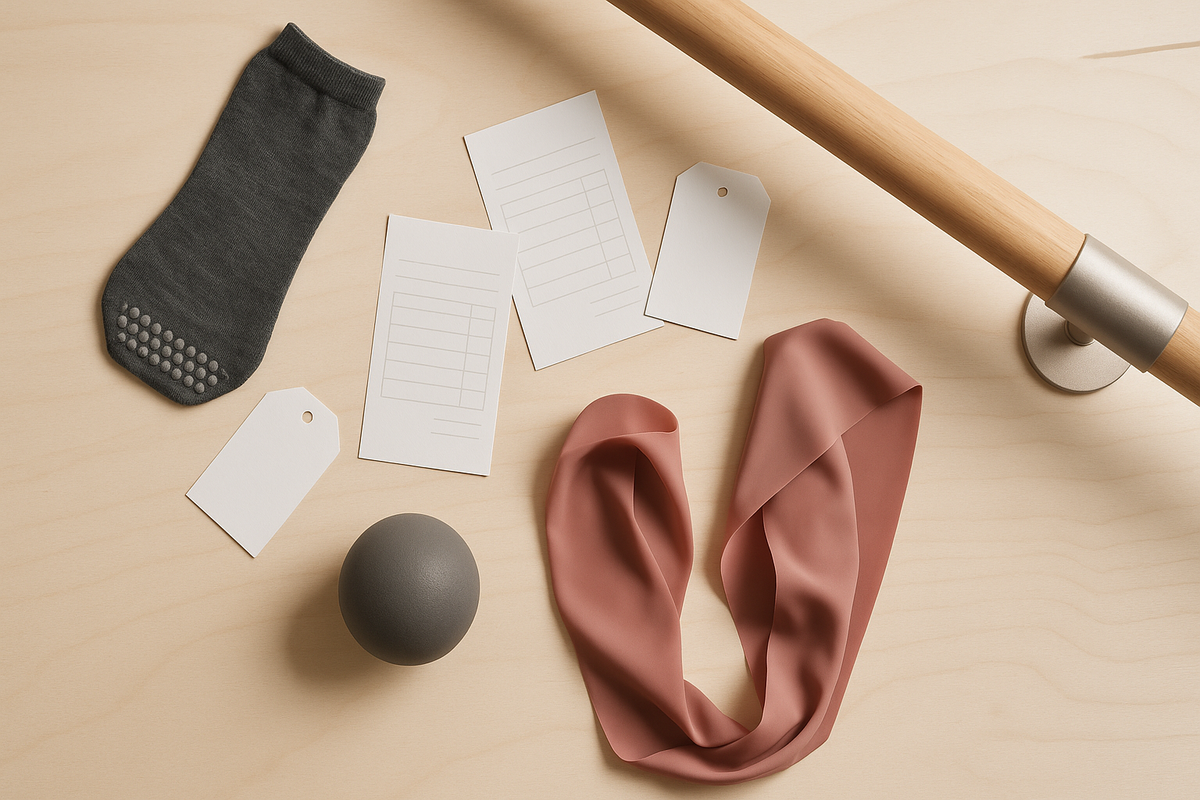
Standard barre class delivery requires a defined props inventory. Most studios provide light weights, a ball, and a tube resistance band at each station. The product type segment is highly diversified, encompassing barre bars, specialized flooring, mirrors, resistance bands in multiple resistance levels, weights, and ancillary accessories.
Resistance equipment has evolved in specificity. Circle resistance bands now come in light (10–15 lbs resistance), medium (20–25 lbs), and heavy (25–55 lbs) options, and instructors report they are game-changers for building strength in upper body, glutes, and legs. For Pure Reform resistance-based formats, studios add sliders and resistance bands or bungees to the standard prop suite. Weight selection remains conservative: most barre exercises need no more than 5 lbs of resistance.
Major US Manufacturers and the Commercial Supply Chain
Vita Barre is the largest U.S. manufacturer of ballet bars and fitness equipment, with barres serving as products of choice for major franchise brands. Vita has custom-developed products with Beachbody for color and logo specifications, Pure Barre for unique class offerings, and Pottery Barn for wholesale distribution. This positioning as the franchise standard-bearer gives Vita significant pricing power in the commercial studio segment.
Three other suppliers dominate the professional market. Custom Barres sets the global standard for professional ballet barres, with installations in elite studios, rehabilitation facilities, universities, and luxury homes. En Pointe is a leading manufacturer and distributor of professional ballet dance equipment serving ballet schools, dance studios, and fitness studios across North America. Alvas created the first production Ballet Barre Bracket in 1952, introduced the FloatFloor used by professional dancers, and pioneered Glassless Mirrors for the dance and fitness industry. Per industry analysis, manufacturers continuously innovate in materials, portability, and adjustability, with commercial studios opting for durable, high-capacity barres while home users prefer compact, easy-to-install designs.
Smart Equipment and Technology Integration Accelerates in 2025–2026
The barre equipment category is experiencing rapid digitalization. Development of smart barre equipment integrated with technology for tracking performance metrics has garnered significant attention, appealing to tech-savvy consumers who expect connected fitness experiences. Integration of smart features such as digital tracking and app connectivity is enhancing user engagement and providing value-added benefits that justify premium pricing.
Barre3 offers a digital platform with more than 1,200 classes built around strength, cardio, and mindfulness, plus a B3 Shop with props, kits, and activewear; the brand has partnered with wearable company Whoop to add performance analytics to the member experience. Studio operators are also adopting Bar Type Display technology that presents dynamic class schedules, instructor profiles, and real-time updates, enhancing customer experience and differentiating boutique fitness settings where ambiance and engagement drive retention.
Sustainability Becomes a Purchasing Criterion
The increasing focus on sustainability, with use of eco-friendly materials and manufacturing processes, is resonating with environmentally conscious consumers and expanding the addressable market. Brands across the supply chain are offering sustainable and environmentally friendly barre accessories, aligning with the values of a growing consumer segment that prioritizes green purchasing decisions.
For studio operators, sustainability claims must be verifiable. As consumer sophistication increases, greenwashing risks alienating the very clientele attracted to eco-friendly positioning. Operators should request certifications, material sourcing documentation, and end-of-life recycling information when evaluating sustainable equipment vendors.
Franchise Consolidation and Equipment Standardization in 2025
Barre3 acquired San Diego-based Studio Barre in February 2025, and the acquired brand's 11 studios across California, Montana, Rhode Island, and South Carolina will convert to barre3 branding and standards. Barre3 now has more than 200 studios open or in development across the United States, Canada, and the Philippines. This consolidation signals a shift toward equipment standardization as larger brands acquire independents and retrofit locations to franchise specifications.
For independent studio operators, this trend creates both competitive pressure and opportunity. Consolidation may reduce equipment vendor diversity as major franchises negotiate volume contracts with preferred suppliers, but it also clarifies the independent value proposition: flexibility to source cost-effectively without franchise markup.
The Franchise Markup Problem: Real Numbers on Props and Consumables
Franchise equipment procurement presents a persistent cost challenge. According to franchisor-to-franchisee pricing analysis, franchisors may charge $140 for a branded mat when wholesale cost is $40, a $100 difference per mat that totals $3,000 for an initial order of 30 mats. Similarly, franchisors charge $9 per pair of sticky socks versus $4 wholesale; a studio purchasing 5,000 pairs annually pays a $25,000 annual markup over direct wholesale pricing.
These cost structures directly affect unit economics and franchisee profitability. While franchisor arguments for quality control and brand consistency have merit, the spread between wholesale and mandated pricing creates tension, particularly as independent studios publicize their cost advantages in local markets.
What This Means for Studio Owners
Editorial analysis – not reported fact:
If you're opening a studio in 2026, your equipment decisions will materially affect both your startup capital requirements and your ongoing margin structure. Franchise models offer turnkey equipment packages, brand recognition, and tested supplier relationships, but you'll pay a premium of 30–40% on consumables and have limited flexibility to optimize costs as your business matures. Independent studios gain procurement freedom and lower equipment costs but must invest time in vendor evaluation, quality assurance, and equipment maintenance planning without franchisor support.
The technology integration trend is not optional for competitive positioning. Studios that adopt smart equipment, digital class displays, and performance tracking will differentiate in markets where boutique fitness competition is intense. However, technology purchases require careful ROI analysis: a $10,000 investment in Bar Type Display and connected equipment must drive measurable improvements in member retention, class utilization, or premium pricing to justify the capital outlay.
For established studios evaluating equipment refresh cycles in 2026, sustainability positioning offers differentiation opportunity but requires authentic commitment. Your clientele will research claims, and superficial greenwashing will damage trust. If you invest in eco-friendly equipment, integrate the story into your studio narrative, member onboarding, and social proof, and be prepared to document material sourcing and lifecycle impacts when asked.
Sources & Further Reading
- Grand View Research Barre Equipment Market Report – comprehensive market sizing, growth projections, and trend analysis for the global barre equipment industry through 2033
- FranchiseHelp Pure Barre Franchise Cost Analysis – detailed breakdown of Pure Barre franchise investment requirements including equipment and FF&E packages
- Real Barre Franchise vs. Independent Studio Cost Breakdown – comparative analysis of equipment costs, recurring expenses, and cost-saving strategies for independent operators
- Franchising.com on Barre3's Acquisition of Studio Barre – February 2025 consolidation announcement and implications for equipment standardization
- Vita Barre – largest US manufacturer of ballet bars and fitness equipment, supplier to major franchise brands
- Custom Barres – professional ballet barre manufacturer serving elite studios and institutions
- En Pointe – North American manufacturer and distributor of professional ballet and fitness equipment
- Alvas – innovator in ballet barre brackets, FloatFloor, and Glassless Mirrors since 1952
- Barre3 – franchise brand digital platform, equipment specifications, and Whoop wearable partnership details
Editorial coverage of publicly reported industry developments. Barre Diary has no commercial relationship with any companies named.