Starting Your Barre Practice: Studio vs. Home Setup Guide
Classical vs. modern formats, essential equipment for home practice, realistic frequency for beginners, and what to expect in your first four weeks of barre.
Key Takeaways
- Format origins matter for setting expectations: Classical Lotte Berk-style barre emphasizes isometric holds and slower pacing, while modern hybrids like Physique 57's Interval Overload method use faster, fatigue-focused intervals; beginners don't need to pick sides but should understand these differences shape class intensity and pacing.
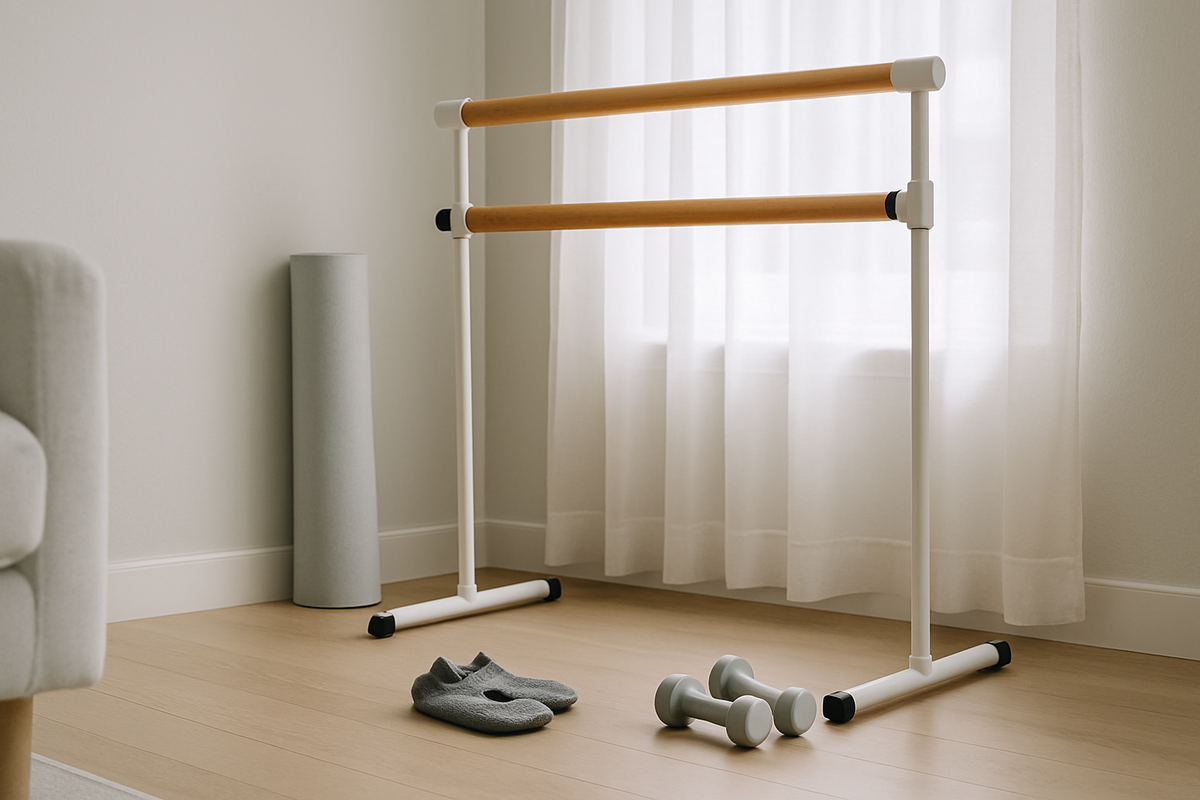
- Home practice requires minimal investment: A 6x6-foot clear space, sturdy chair or countertop, 1.5kg (3lb) hand weights, exercise mat, and 8-9 inch playground ball cover essentials; a mirror is highly recommended for form checks, especially during the first weeks.
- Studio vs. home trade-offs center on correction and convenience: Studios provide hands-on adjustments from trained instructors and beginner-specific classes that explain terminology, while home setups eliminate travel friction and offer privacy at lower cost; both formats deliver measurable results when practiced consistently.
- Beginners should start with 2-3 sessions per week: This frequency builds strength and flexibility while allowing recovery time for thighs, glutes, calves, and core; practitioners report feeling tighter, firmer, and more toned after just a few weeks at this cadence.
- Physical results appear within 4 weeks, but expect initial muscle hypertrophy: New practitioners may notice muscles become more defined before slimming down because barre activates smaller stabilizer muscles unaccustomed to work; flexibility, strength, and posture improvements are typically evident within a few weeks.
- First-class nerves are universal and temporary: Feeling shaky or uncoordinated is normal; instructors recommend avoiding comparison with veteran students and focusing on engaging the right muscles with modifications as needed.
Why Barre Format History Shapes Your First Class Experience
Barre fitness began in 1959 when dancer Lotte Berk developed a method combining rehabilitative exercises with ballet-inspired movements after a back injury. Classical Lotte Berk-style workouts emphasize isometric contractions and small-range movements within ballet positions like pliés and arabesques, creating the characteristic "burn" through sustained holds. Modern studios have evolved the format in different directions.
Physique 57, for example, uses a proprietary Interval Overload method that challenges muscles to fatigue then stretches them, with researchers confirming measurable body composition changes in just four weeks. The tension between authentic slow-paced isometric work and high-intensity interval variants continues among experienced practitioners, but beginners benefit from understanding that these format differences directly affect class pacing, fatigue patterns, and which muscle groups dominate each session.
Studio Classes Offer Structure and Real-Time Correction
Studios typically recommend arriving 10-15 minutes early to complete new client forms, tour the facility, and discuss any injuries or limitations with instructors. Bar Method instructors, for instance, undergo rigorous training to provide verbal and hands-on adjustments informed by physical therapists, ensuring modifications suit all abilities. Beginner-focused classes spend significant time explaining terminology and core positions, helping new students learn proper form and body alignment from the start.
This real-time feedback loop is the studio model's primary advantage. Instructors can spot compensatory movement patterns, misaligned hips, or insufficient core engagement that would go unnoticed at home. For students recovering from injury, managing chronic conditions, or entirely new to strength training, this guided environment reduces injury risk and accelerates technical mastery.
Home Practice Removes Friction with Minimal Equipment Investment
Setting up a home barre studio requires minimal investment and delivers convenience, privacy, and cost savings compared to boutique studio memberships. Must-have equipment typically includes a sturdy chair or countertop for balance, 1.5kg (3lb) hand weights, an exercise mat, and an 8-9 inch playground ball for lower body and core work. The ball's lightweight construction provides just enough resistance to engage muscles without straining joints.
Choose a clear area approximately 6x6 feet with non-slip flooring, access to a stable surface, good lighting, and adequate ventilation. A mirror is highly recommended for form checks, especially valuable for beginners still learning proper hip and shoulder alignment. Online workouts primarily use body weight along with these basic tools, and barre exercises performed at home are just as effective as studio sessions when practitioners maintain consistent frequency and focus on technique.
Online Platforms Expand Access and Scheduling Flexibility in 2026
The rise of on-demand and livestream platforms has fundamentally changed how beginners access barre instruction. Brit Shimansky, a former professional ballerina and master barre instructor who became a mom in 2020, launched Britsbarre as a virtual studio built around short, beat-driven barre and strength classes designed for time-constrained parents. Online studios now offer all-levels libraries with classes ranging from 10-minute targeted sessions to full hour-long workouts, plus livestream options that provide real-time feedback from instructors.
All-access virtual memberships deliver unlimited class access at monthly costs comparable to a single boutique studio drop-in, making consistent practice financially viable for more people. As of mid-2026, this accessibility has brought barre to practitioners in smaller markets without local studio options and to caregivers whose schedules make fixed class times impractical.
Realistic Frequency and What to Expect in the First Four Weeks
Beginners should start with 2-3 barre workouts per week to build strength, improve flexibility, and enhance overall fitness while allowing adequate recovery time for thighs, glutes, calves, and core. Some practitioners who maintain 3-5 sessions weekly report their body feeling tighter, firmer, and more toned with improved balance, posture, and strength after just a few weeks. However, instructors emphasize that beginners who push to five sessions immediately should listen carefully to their body's recovery signals.
Physical results typically become visible within a few weeks, though the inward transformation in body awareness and postural control starts immediately. If new to strength training, expect muscles to become more defined before slimming down. This initial muscle hypertrophy occurs because barre activates smaller stabilizer muscles unaccustomed to sustained work in other exercise formats. Researchers working with Physique 57 confirmed measurable body composition changes within four weeks of consistent practice, validating what long-term practitioners have reported anecdotally.
Managing Beginner Nerves and the Comparison Trap
Feeling shaky, uncoordinated, or behind others during a first class is universal and temporary. Instructors advise beginners not to compare themselves to others because some practitioners have been attending for years. Barre is a practice similar to yoga in that students are always learning and evolving regardless of experience level. Focus on engaging the right muscles and listening to your body rather than matching the range of motion or speed of nearby students.
Instructors offer continuous cues and modifications throughout class. If a beginner-specific class is available, that format allows instructors to spend more time explaining terminology and foundational positions, helping new students learn correct form and body mechanics. Some studios also offer introductory private sessions, which accelerate technical learning and help prevent compensatory movement patterns that could lead to injury as intensity increases.
What This Means for Studio Owners
Editorial analysis — not reported fact:
The home-studio question is not binary for most beginners. They will sample both, and your job is to articulate what your studio delivers that a mirror and a kitchen counter cannot: real-time postural correction, community accountability, and a beginner curriculum that builds technical foundations before intensity. Make your new-client onboarding process frictionless. The 10-15 minute early arrival window should feel like hospitality, not paperwork. Train your instructors to name and normalize first-class discomfort out loud so beginners don't self-select out after one awkward session.
If you offer virtual options, position them as a bridge rather than a replacement. A hybrid student who takes two studio classes and one home session weekly is more retained than someone forced to choose. Consider offering short beginner technique videos (5-7 minutes covering plié alignment, neutral pelvis, and shoulder engagement) as free pre-class homework. This moves foundational instruction out of limited class time and lets beginners arrive with vocabulary and body awareness already seeded.
Finally, update your results messaging to reflect the muscle-definition-before-slimming reality. If beginners expect to "slim down" in four weeks but instead see more muscular definition, they may perceive failure when they've actually made textbook neuromuscular adaptation progress. Reframe early hypertrophy as a strength and metabolic win, not a detour.
Sources & Further Reading
- Bar Method beginner's guide to barre class — new client onboarding recommendations, instructor training approach, and first-class expectations
- Physique 57 Interval Overload methodology — proprietary format details and research on four-week body composition changes
- Britsbarre virtual studio — platform launched by former ballerina Brit Shimansky for time-constrained parents, with short on-demand classes
- Verywell Fit guide to at-home barre workouts — equipment recommendations, space requirements, and effectiveness compared to studio practice
- SELF magazine at-home barre setup — minimal investment requirements and equipment substitutions
- Shape magazine barre workout guide — frequency recommendations, beginner progression timelines, and expected physical results
- Lotte Berk biography and method origins — historical context for classical barre technique development
Editorial coverage of publicly reported industry developments. Barre Diary has no commercial relationship with any companies named.